Who this is for
This blueprint is for school leaders, academic coordinators, and teachers who want to run NEET preparation inside their own school with limited budget and staff.
What you will build (the minimum viable system)
- One official source of truth for the syllabus and exam pattern
- A micro-syllabus that converts topics into weekly teach-practice-test cycles
- A testing engine with simple analytics and error correction
- Teacher enablement focused on NEET-style questions and exam temperament
Part 1: Start with the official rules of NEET
Do not guess. Always begin with the latest official NEET documents and lock them for the year.
Exam pattern snapshot (official)
As per the NEET (UG) 2025 Information Bulletin (last updated on January 2, 2026 on the NEET portal), NEET (UG) 2025 uses the pre‑COVID pattern:
| Parameter | Details |
|---|---|
| Subjects | Physics, Chemistry, Biology (Botany and Zoology) |
| Questions | 180 compulsory questions in 180 minutes |
| Total Marks | 720 with +4 for correct, -1 for incorrect, 0 for unattempted |
| Mode | Single‑day pen‑and‑paper (OMR) exam |
Syllabus source of truth (NEET UG 2026)
The National Medical Commission (UGMEB) issued an official notice on December 22, 2025 with the updated syllabus for NEET (UG) 2026. Treat this syllabus PDF as the contract. Everything you teach, practice, and test must map to it.
Part 2: Build a simple NEET Cell inside the school
You do not need a large department. A small cross‑functional team is enough.
NEET Cell roles
| Role | Responsibility |
|---|---|
| Program Director (Academic Lead) | Own the calendar and quality checks |
| Subject Leads (Physics, Chemistry, Biology) | Own sequencing and question quality |
| Testing and Analytics Coordinator | Run OMR tests and track results |
| Student Mentors (1 per 25 to 40 students) | Track discipline and backlogs |
Weekly NEET Cell meeting agenda
- Coverage versus plan
- Test results and top error patterns
- Decisions for next week: reteach, extra DPP, or batch split
Part 3: Convert the syllabus into a micro-syllabus
The syllabus is a list of topics. Students need a weekly plan with clear targets.
Step-by-step method
Micro‑Syllabus Tracker (required)
Create a one‑page tracker per subject and review it weekly.
| Chapter | Start | End | DPP Target | Test Date | Target Accuracy | Backlog Status |
|---|---|---|---|---|---|---|
| Kinematics | 2026-04-01 | 2026-04-10 | 120 Qs | 2026-04-12 | 70% | On track |
Part 4: Minimum viable materials (low budget)
You do not need expensive books to start.
- NCERT Class XI and XII textbooks for Physics, Chemistry, Biology
- Official NEET documents and notices on the NEET portal
- National Test Abhyas app for exam‑level mock tests and practice analytics
- School‑created DPPs, weekly tests, and an error‑log workbook
Part 5: The 24‑month operating plan for NEET preparation
Use this default timeline for integrated Class XI and XII batches. If you run a one‑year program, compress the phases but keep the same rhythm.
Phase 0: Setup and diagnostics (Weeks 1 to 2)
Goal: Know where students are starting and create batches.
Actions:
- Run diagnostic tests in Physics (math readiness), Chemistry (bonding basics), and Biology (NCERT recall)
- Create three cohorts: Foundation, Standard, Advanced
- Publish the first 8‑week micro‑syllabus
Phase 1: Foundation and first coverage (Months 1 to 8)
Goal: Complete first‑pass coverage with heavy practice.
Weekly rhythm:
- 5 days concept plus guided practice
- 1 day sectional test
- 1 day review and backlog clearing
Phase 2: Full coverage and mixed tests (Months 9 to 14)
Goal: Move from chapter tests to mixed tests.
Actions:
- Fortnightly mixed tests across Physics, Chemistry, Biology
- Monthly full or partial syllabus tests
Phase 3: Revision cycles (Months 15 to 20)
Goal: Two to three revision loops with targeted correction.
Revision loop: Revise → Test → Error‑fix → Retest
Phase 4: Final sprint (Last 8 to 10 weeks)
Goal: Exam temperament and score stability.
Actions:
- Two full tests per week in OMR format
- Daily error‑log drills
- Strict routine and anxiety management
Part 6: Build the testing engine (your secret weapon)
Testing discipline creates results even without coaching partnerships.
Minimum testing blueprint
| Test Type | Frequency |
|---|---|
| Chapter or unit tests | Weekly |
| Mixed tests | Fortnightly |
| Full or partial syllabus tests | Monthly |
| Final phase full tests | Two per week |
What to measure every week
- Score trend
- Accuracy percentage overall and by topic
- Attempt rate
- Negative marks per test
- Time pressure and unattempted count
Part 7: Daily student system
In school hours
- One concept class (45 to 60 minutes)
- One guided practice block (45 to 60 minutes)
After school (2 to 3 hours)
- DPP practice (60 to 90 minutes)
- NCERT reading and diagrams (30 to 45 minutes)
- Error log update (10 to 15 minutes)
The Error Log (non‑negotiable)
Part 8: Teacher enablement (4‑week plan)
Great teachers still need NEET‑specific preparation.
| Week | Focus |
|---|---|
| Week 1 | NEET orientation: Exam pattern and marking rules, OMR discipline and time management |
| Week 2 | NCERT‑first teaching: Line‑to‑question method, building NEET‑level questions from NCERT |
| Week 3 | Question design: Chapter test blueprint, common distractors and traps |
| Week 4 | Remediation and analytics: Reading item analysis, 15‑minute micro‑lessons for weak concepts |
Part 9: Parent and student mentoring
Schools win when parents and mentors act early.
Parent updates (monthly)
- Attendance and test score trend
- Topics completed and backlog alerts
- One simple action for the week
Mentor rhythm (weekly)
- Check student backlog
- Review error log
- Set next‑week goals
Part 10: 30 / 60 / 90 day checklist
Use this to start immediately.
First 30 days
Day 31 to 60
- Teachers build DPPs and chapter tests
- Students begin error logs
- Parent communication cadence begins
Day 61 to 90
- Item analysis after every test
- Remediation cycles for weak chapters
- Introduce mixed tests
How all.school supports this blueprint
Use these modules to reduce manual effort and keep the system consistent.
| Module | How it helps |
|---|---|
| Knowledge + AI | Curriculum mapping, notes, and NEET micro‑syllabus tracking |
| Learning Forge | Question banks, DPPs, and test analytics |
| Academic Ops | Weekly calendar, attendance, and discipline rhythm |
| Teacher Hub | Teacher training records and subject ownership |
| Student & Parent | Parent visibility and student progress updates |
If you want a walkthrough, start with the platform overview or book a demo.
FAQ (for school leaders)
Can a school run NEET prep without a coaching partnership?
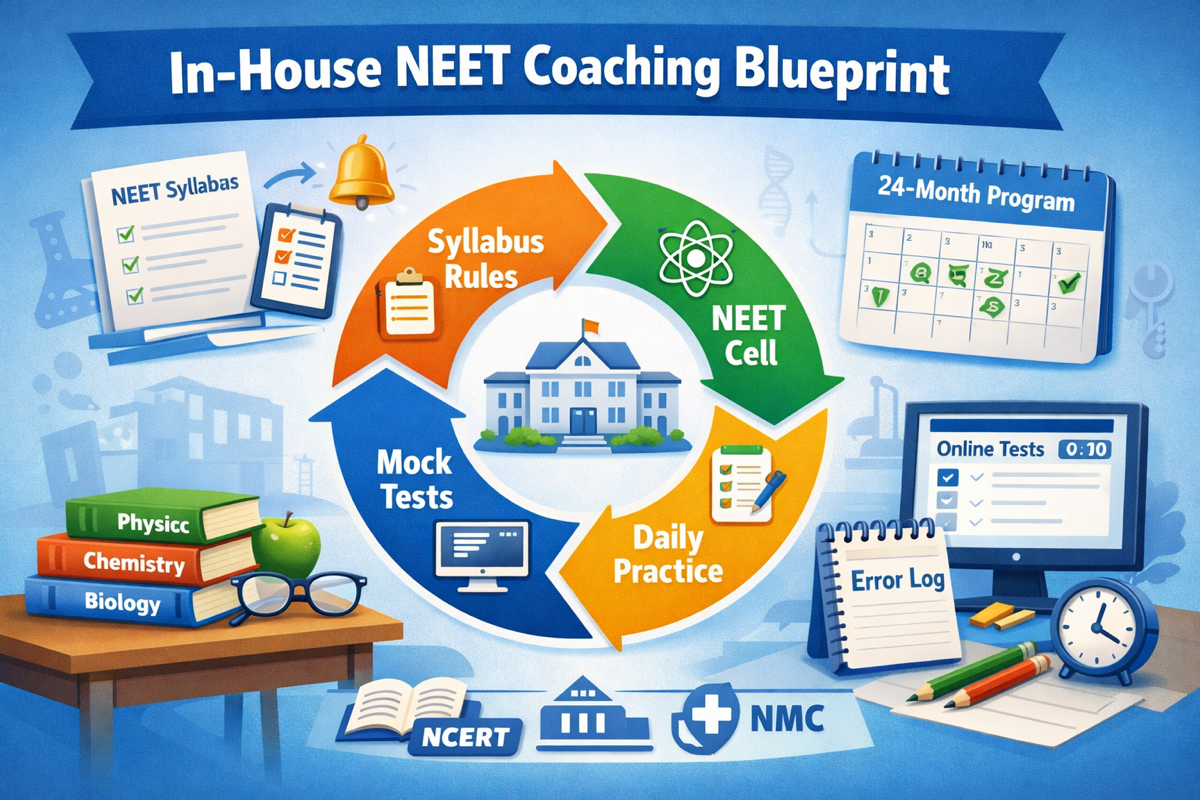
Yes, if the school runs a weekly system: syllabus to micro‑plan, micro‑plan to practice, practice to tests, tests to correction. The system matters more than any external brand.
Do we need separate NEET faculty?
Not necessarily. Many schools succeed by training their existing teachers in NEET‑style pedagogy and testing patterns, then adding a tight feedback loop.
What if our students are from multiple language backgrounds?
NEET is conducted in multiple languages. Use the latest Information Bulletin for the current list and plan language support early.
How do we keep parents involved without creating pressure?
Keep updates simple: attendance, test trend, and one clear action for the week. Avoid long reports.
Official links and resources
| Resource | Link |
|---|---|
| NEET portal | neet.nta.nic.in |
| NEET Information Bulletin (latest year) | NEET (UG) 2025 Bulletin |
| Syllabus for NEET (UG) 2026 | Updated Syllabus PDF |
| NCERT textbook PDFs | NCERT Textbooks |
| National Test Abhyas app | National Test Abhyas |
Final takeaway
You do not need a big coaching partnership. You need a weekly system that schools can actually run: official syllabus, micro‑plan, testing discipline, and teacher enablement.
Start small, stay consistent, and build a school‑owned question bank over time.
If you want a ready‑to‑use micro‑syllabus tracker and a month‑by‑month NEET calendar, we can build it for your school. Visit Pricing or book a demo.