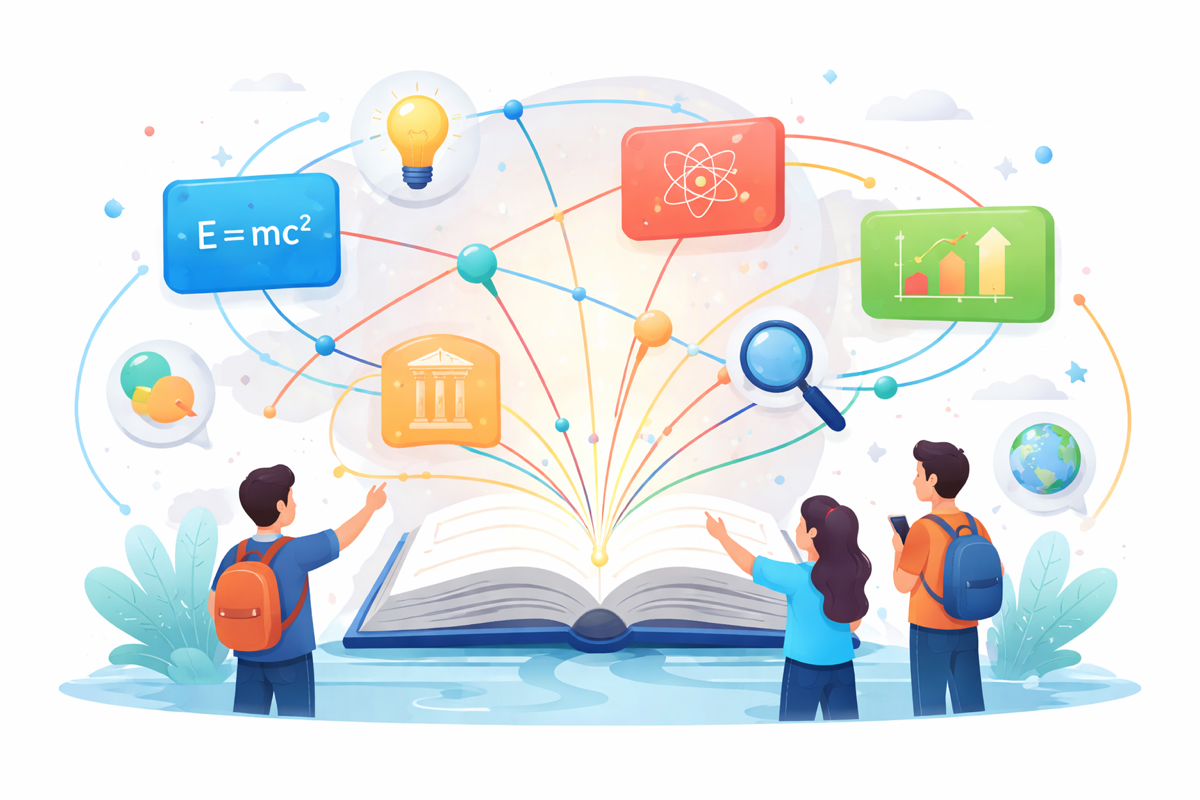
In Education, Dots Must Be Connected to Have Meaning
TL;DR: Students don’t struggle because they can’t “learn facts.” They struggle because schools often fail to help them connect ideas across time, subjects, and experiences. Real learning is synthesis—and systems should be built for that.
“You can only connect the dots looking backward”… but why wait?
Steve Jobs famously said you can only connect the dots looking backward.
But what if schools were designed to help students connect them in real-time?
Because in education, a “dot” is everywhere:
- a formula in Math
- a concept in Science
- a paragraph in English
- a historical event in Social Studies
- a skill like collaboration, persistence, or reflection
The problem is not a lack of dots.
The problem is that dots are often stored… not connected.
The Learning Wall: when accumulation stops working
Many students hit a point where “studying more” doesn’t help.
They memorize. They practice. They repeat.
And still, the learning feels fragile.
That’s the Learning Wall:
- facts don’t convert into understanding
- practice doesn’t transfer to new questions
- chapters don’t combine into a mental model
- exam prep becomes cramming instead of mastery
It’s similar to the semiconductor world: raw compute is powerful, but without fast transfer and coordination, performance stalls.
In learning terms:
- knowledge without connection becomes isolated memory
- skills without context become brittle routines
- content without synthesis becomes noise
Schools have a connection problem (a bandwidth problem)
Most schools are full of talented teachers and hard-working students.
Yet the system often operates like separate islands.
1) Subject silos
Math doesn’t “talk” to Science.
Language doesn’t reinforce Social Studies.
Students are left to guess:
- “Is this the same idea in another class?”
- “Why are we learning this here but not there?”
- “When will I ever use this?”
2) Grade-to-grade gaps
Grade 5 often doesn’t truly build on Grade 4.
A new year starts, a new teacher begins, and key context gets lost:
- what the student already struggled with
- which explanations worked
- what “mastery” actually looked like
3) Teacher knowledge doesn’t compound
Teachers create excellent resources:
- flashcards
- worksheets
- lesson plans
- activities
- formative quizzes
But often these stay in personal folders, not shared systems.
So each year, new effort is spent recreating dots instead of connecting them.
4) Parent visibility is disconnected from learning
Parents usually see outcomes:
- marks
- homework completion
- report cards
But not the learning path:
- what skills are being built
- what concept is being reinforced
- what the next step should be at home
That missing “feedback loop” reduces support at the exact moment students need it.
Connection creates compound value
A dot is useful.
But the value of learning grows exponentially when dots are connected into a map.
Here’s what connection looks like in practice:
- A teacher makes flashcards that link to…
- the chapter concept they represent, which links to…
- a short practice set, which links to…
- a quick assessment, which links to…
- feedback (what went wrong and why), which links to…
- parent visibility (how to help at home), which links to…
- a revision plan, which links to…
- mastery evidence and next-level challenges
That’s not “more content.”
That’s a system.
And systems create compound value:
- less repetition for teachers
- faster clarity for students
- better support for parents
- stronger consistency across grades
Looking backward to connect forward
One of the biggest motivation killers is this sentence:
“Why are we learning this?”
Students rarely see the value in the moment.
Years later, it clicks—like Jobs and calligraphy.
But education shouldn’t depend on delayed understanding.
Great learning environments help students connect dots faster by making the purpose visible:
- where this concept came from
- what it unlocks next
- what real-world problems it helps solve
- how it connects to something they already know
A simple example: “percentages”
If percentages stay in the math workbook, it feels abstract.
But when connected, it becomes:
- discounts and GST calculations
- cricket stats and averages
- science concentration and mixing solutions
- finance, interest, profit margins
- data interpretation and charts
Now the student isn’t just memorizing.
They’re building a mental network.
What it looks like when schools are designed for connection
Connection isn’t a motivational poster.
It’s a design problem.
And it shows up in everyday school operations.
For students
- clear learning pathways (“here’s what you know → here’s what’s next”)
- frequent low-stakes checks for understanding
- revision that is targeted, not random
- explicit cross-topic links (“this is the same pattern as…”)
For teachers
- shared resource libraries that evolve each term
- visibility into what the previous grade taught and how
- quick ways to tag, reuse, and improve content
- feedback loops that show what worked (and what didn’t)
For parents
- clear visibility into the current concept and goal
- simple, actionable “help at home” guidance
- early warnings before exam time
- progress framed as skills, not just marks
A practical mindset shift: from “coverage” to “coherence”
Many schools optimize for coverage:
- finish the syllabus
- complete the textbook
- conduct the exam
But students don’t need more dots.
They need coherence.
A useful checklist for coherence:
- Can the student explain why the idea exists?
- Can they connect it to a previous idea?
- Can they apply it in a new context?
- Can they teach it in simple words?
- Can they recognize it across subjects?
If the answer is “no,” the dot is still isolated.
Takeaway and next step
Dots must be connected.
And in education, that connection is the learning.
Next step: Pick one current topic your child or students are learning and create 3 explicit links:
- one link to a previous concept (“this is like…”)
- one link to another subject (“this shows up in…”)
- one link to real life (“you’ll use it when…”)
Repeat weekly.
Over time, students stop memorizing in fragments—and start thinking in systems.
Build your school’s knowledge system. all.school’s Knowledge + AI module helps schools capture curriculum content, create study decks, and build an institutional knowledge base that grows stronger over time. Explore the platform.