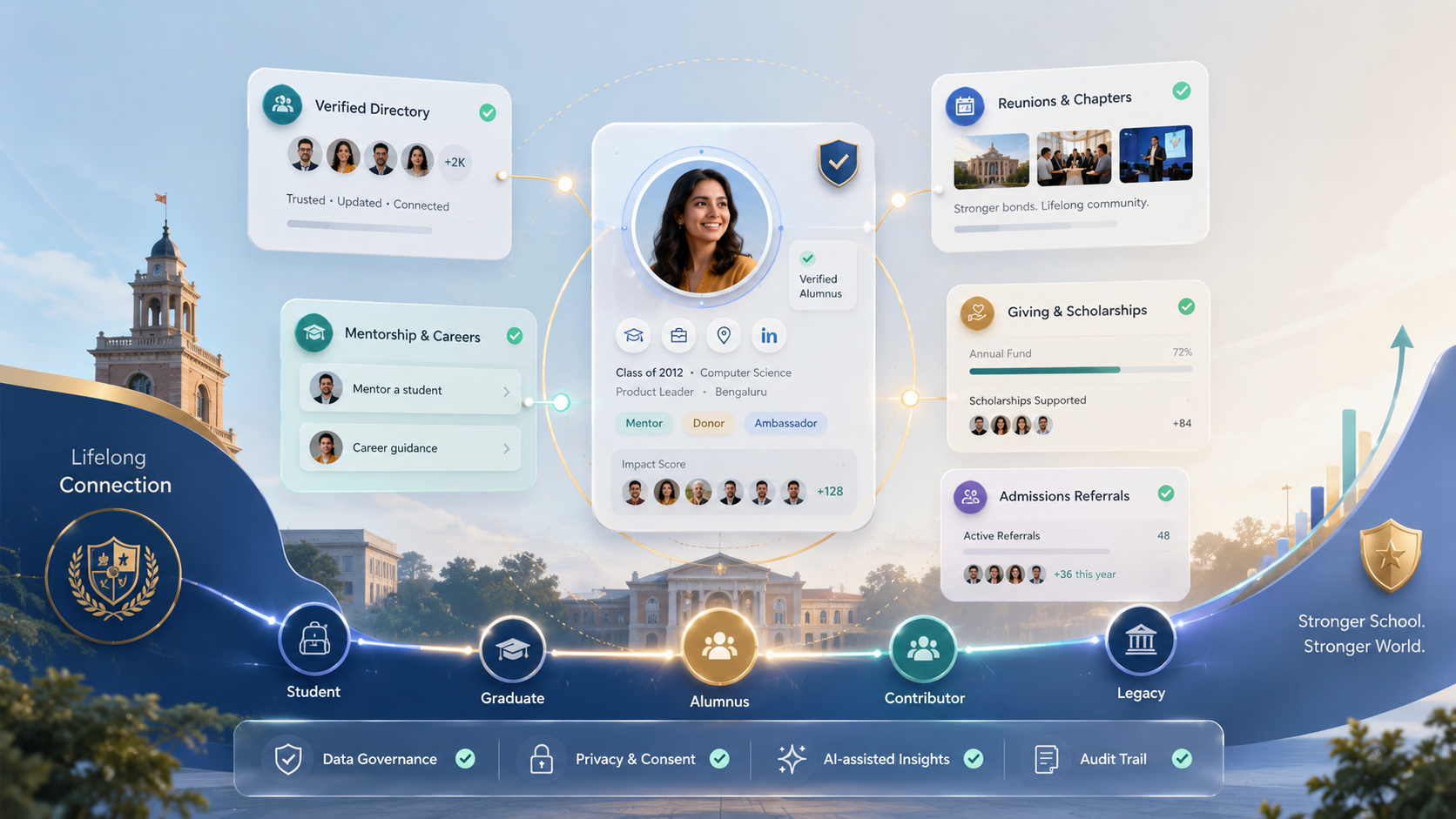
The cost of a “graduating class” mindset
Every Indian school invests something extraordinary in each student: 12 years of relationships, hundreds of teachers, thousands of hours of attention, and an institutional memory of who that child was — both the academic record and the human story behind it.
And then, in most schools, on the morning after graduation day, that investment is quietly closed and shelved.
The class WhatsApp group runs for a year, dies in two. A dusty register lists “old students” with phone numbers from 2014. The principal’s office gets one call every six months from someone in Bengaluru asking, “Sir, do you remember me?”
Meanwhile the school keeps doing the same thing it did before — chasing admission leads cold, fundraising from scratch, hoping current students get good college guidance, watching its own graduates build remarkable lives in cities the school has no presence in.
You don’t lose alumni at graduation. You lose them at infrastructure.
The schools that compound — the ones that have a “feeder reputation”, a real scholarship pipeline, a queue at admissions, a steady stream of mentors and donors — almost always treat alumni as a lifelong relationship and advancement asset, not a static contact list.
This is the alumni playbook for Indian schools that want to start playing that long game.
Why alumni networks matter (more than schools realize)
Most school leaders intuitively know alumni “matter”. What’s less obvious is how much, and across how many parts of the school’s life. Five concrete leverage points:
1. Admissions
Top schools in India routinely report that 40–60% of new admissions trace back to a recommendation — a current parent, a neighbour, a teacher, and very often a former student. Every alumni family becomes a household-level marketing channel that no Instagram ad can compete with.
2. Mentorship for current students
A Class XII student deciding between engineering and design will not be moved by a brochure. They will be moved by a 25-minute Zoom with a 2018-batch alumna who walked the same path. Mentorship from alumni is one of the highest-leverage interventions a school can offer — and one of the cheapest.
3. Fundraising
Library renovations. Scholarship funds. Lab upgrades. Sports sponsorships. Most Indian schools have unspent capacity in their physical and academic plant that could be unlocked with even a fraction of what their alumni would happily contribute — if asked properly.
4. Reputation
In 2026, school reputation is built on LinkedIn and WhatsApp, not on local newspapers. One alumni post — “10 years ago my school taught me X” — reaches more parents than three months of paid promotion. You cannot manufacture this. You can only earn it, and stay close enough to your alumni for it to happen.
5. Student outcomes
Career talks. Mock interviews. Internship pipelines. College application reviews. These don’t need to be expensive consulting programs. They need a 200-person network of alumni you can target by city, profession, and willingness — this term, not next year.
The seven jobs of an alumni network
Most schools that try to “do alumni” do one or two of these and call it done. The schools that compound do all seven, badly at first, then better over time. The point is to set up the system so you can keep iterating.
| # | Job | What “good” looks like |
|---|---|---|
| 1 | Verified directory | A profile per alumnus with batch, city, profession, company, willingness — that they can update |
| 2 | Graduation flow | Final-year students convert to alumni in one step; “Class of YYYY” is auto-created |
| 3 | Mentorship & careers | Open calls for mentors, guest speakers, internships, jobs — with response tracking |
| 4 | Reunions & events | RSVP, guest count, check-in, attendance — wired into the school calendar |
| 5 | Giving campaigns | Pledges, contributions, voucher-linked receipts — separate from your books, audit-clean |
| 6 | Chapters & networks | Bengaluru, Chennai, Dubai chapters; entrepreneurs, doctors, civil services groups |
| 7 | Engagement scoring | Every interaction logged; you know who your most active alumni are without guessing |
This is the structure. Everything else — the warmth, the relationships, the storytelling — sits on top of it.
Why most schools fail at this
The intent is almost always there. The infrastructure isn’t.
Three failure modes show up again and again:
Failure 1: The spreadsheet trap
A coordinator opens an Excel file in 2014. By 2018 it’s three sheets. By 2022 it’s lost. By 2026 someone in the office “thinks Manju ma’am has a copy”. The data is unverifiable, undisputed, and unused.
Failure 2: The disconnected portal
The school buys a separate “alumni portal” tool. It has a beautiful login page. It is never updated, because updating it means duplicate entry — once into the school ERP, once into the alumni tool. Six months later the portal is dead.
Failure 3: The personality dependency
The whole alumni programme rests on one charismatic teacher who knows everyone personally. When she retires or moves, the network goes with her. Nothing institutionalised survives.
The integrated approach
The alternative is straightforward in principle and difficult in execution: alumni shouldn’t live in a separate tool. They should live in the same school ERP, on the same record they already had as a student, with full continuity from admission to graduation to alumni status.
When that happens, four things become possible that aren’t possible otherwise:
One identity, end to end
A student is admitted as Aarti Menon. She moves through twelve grades. She graduates in 2018. She becomes “Aarti Menon, Class of 2018, Bengaluru, Software Engineer at Razorpay”. The same record. The same history. No re-entry, no duplication, no “I think we have her old phone number somewhere”.
Audience filters that read like sentences
“Bengaluru software engineers from the 2018 batch.”
“Mentor-ready alumni in Chennai.”
“Donor-interest alumni from any batch in Dubai.”
When alumni live with the rest of your school data, audience targeting stops being a chore and starts being a sentence. Send messages. Run campaigns. Find mentors. All from the same composer your school already uses.
Pledges that don’t break your books
This one is subtle but important.
When an alumnus pledges ₹50,000 to a library fund, that pledge is a promise, not a transaction. It should not post to your ledger automatically — it isn’t accounting yet.
When the money actually arrives, that is a transaction. It belongs in the standard finance flow: a Payment Received voucher, recorded by your finance team, posting cleanly to the books.
The right model: pledges sit in the alumni module, money receipts flow through your standard finance workflow, and the alumni contribution record links to the finance receipt after finance posts it. Every received rupee is traceable to a specific entry in your books. Audit-clean, by construction.
Chapters and interest groups, built in
Chennai chapter. Bengaluru chapter. Dubai chapter. Entrepreneurs group. Doctors group. Civil services group. These shouldn’t be afterthoughts in a separate “groups” feature. They should be first-class citizens — with their own coordinators, their own audiences, their own events, their own engagement scores.
When you can run a “Bengaluru entrepreneurs from any batch, mentor-ready” query in three clicks, you stop thinking about alumni programmes and start running them.
A practical 90-day playbook
You don’t need to do everything at once. Most successful school alumni programmes start small, prove value, and compound. Here’s a realistic 90-day rollout that any school can run.
Your first 90 days
Days 1–30 — Convert your last three batches. Don’t try to onboard 30 years of alumni at once. Start with the most recent three graduating classes. Their data is freshest, their engagement is highest, and they’ll set the cultural tone for older batches. Use the graduation flow to convert your current Class XII into the next “Class of YYYY”. Import the previous two batches via your existing admission records.
Days 31–60 — Surface mentor-ready alumni. Send one targeted communication to each batch asking a single question: “Are you open to mentoring a current student for 30 minutes a term?” Capture the answer on each profile. You’ll be surprised — the response rate from recent alumni is usually well above 40%. Now you have a mentor pool you didn’t have last month.
Days 61–90 — Run your first targeted reunion. Pick one batch (usually the 10-year reunion is highest-energy) and one city. Use audience filters to invite “Class of 2016, anywhere in India”. RSVP, guest count, check-in. Capture the engagement. Take photos, post them. Six months later you’ll have a story to tell every other batch, and a working playbook for the next ten reunions.
By day 90 you have: a working directory of three batches, a mentor pool, a successful reunion, a campaign reach, and a story. By day 180 you have a credible alumni programme. By day 365 you have something that compounds without needing personality dependence.
What this looks like in all.school
The Alumni Management module in all.school is built specifically around the seven jobs above — and around the principle that alumni shouldn’t live in a separate tool.
A quick map of how each job is supported:
| Job | What you get |
|---|---|
| Verified directory | One profile per alumnus, on the same record they had as a student. Filter by batch, city, profession, willingness. Alumni keep their own profile current via the self-service portal. |
| Graduation flow | One-step conversion of final-year students. “Class of YYYY” batch group auto-created. Student history preserved. |
| Mentorship & careers | Opportunities for mentor calls, guest lectures, internships, jobs, referrals. Track interested → shortlisted → confirmed → completed. |
| Reunions & events | RSVP, guest count, check-in, attendance — wired into the school calendar so events live alongside everything else the school is running. |
| Giving campaigns | Pledges in the alumni module. Receipts through the standard Payment Received voucher in Finance. Audit-clean linkage. |
| Chapters & networks | Chennai, Bengaluru, Dubai chapters. Entrepreneurs, doctors, civil services interest groups. First-class in the data model. |
| Engagement scoring | Every interaction logged with a score. Find your most engaged batches and alumni instantly. Communication audience filters use this directly. |
Plus the things that emerge from putting it all in one ERP: alumni referrals show up in the same admissions pipeline as walk-ins; alumni-led scholarships sit alongside school scholarships; alumni at open houses are tracked the same way as any other guest.
We always knew our alumni were our biggest asset. We just never had a system that treated them like one.
What to do this week
If you’re a school leader reading this, you don’t need a six-month strategy document to start. You need three actions:
- Identify your last three graduating batches. Get a list. Even a partial one.
- Pick one named “alumni champion” on staff — usually a senior teacher who’s been at the school for 10+ years and remembers names. Not a full-time role; a coordinator with one block on their calendar.
- Run the graduation flow this term. When Class XII finishes board exams in March, don’t let them disappear. Convert them on the spot. Class of 2026 should exist as a real batch group before they leave the building.
That’s it. From those three actions, everything else compounds.
If you’d like to see how this looks in practice, take a look at the Alumni Management module or book a 30-minute walkthrough. We’ll show you the directory, the graduation flow, the audience composer, and the voucher-linked giving — and you’ll know in one session whether this fits the way your school already works.